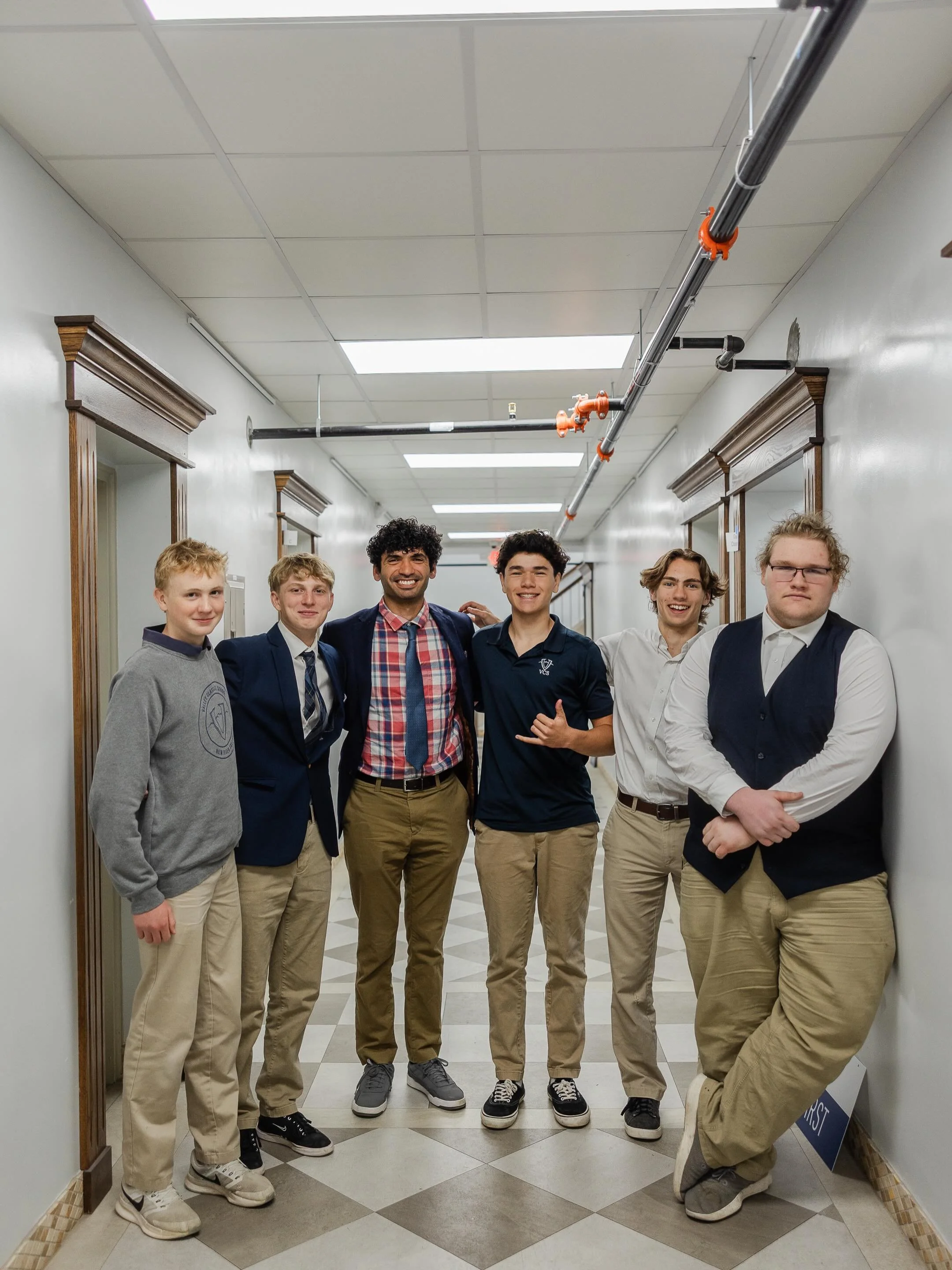
The Torrent Tale

Founded in 2017, VCS has grown from a small school, serving approximately 30 students and 15 families to a thriving educational option in the New River Valley. The goal of education at VCS is that our students grow in passion, depth, and ultimately Godly wisdom. To do this, VCS take a classical, Christian, and collaborative approach to education.
VCS is the first Classical, Collaborative school in the New River Valley. We are distinctive in a number of areas, including the following:
Integrated Classical Curriculum
Cost-Effective Tuition
Involved Parents
Experienced, Christian Teachers
Small Class Sizes
Statement of Faith
The Statement of Faith for Valley Classical School is The Nicene Creed. The Nicene Creed is a fourth-century Christian statement of faith drawn up at the Council of Nicaea to officially proclaim Biblical teaching about the nature of God and the church.
-
I believe in one God,
the Father almighty,
maker of heaven and earth,
of all things visible and invisible.I believe in one Lord Jesus Christ,
the Only Begotten Son of God,
born of the Father before all ages.
God from God,
Light from Light,
true God from true God,
begotten, not made,
consubstantial with the Father;
through him all things were made.For us men and for our salvation
he came down from heaven,
and by the Holy Spirit was incarnate of the Virgin Mary,
and became man.For our sake he was crucified under Pontius Pilate,
he suffered death and was buried,
and rose again on the third day
in accordance with the Scriptures.He ascended into heaven
and is seated at the right hand of the Father.
He will come again in glory
to judge the living and the dead
and his kingdom will have no end.I believe in the Holy Spirit, the Lord, the giver of life,
who proceeds from the Father and the Son,
who with the Father and the Son is adored and glorified,
who has spoken through the prophets.I believe in one, holy, catholic* and apostolic Church.
I confess one baptism for the forgiveness of sins and I look forward to the resurrection of the dead and the life of the world to come. Amen.
*or universal
-
In addition to the Nicene Creed, VCS affirms the following:
Introduction
Valley Classical School proudly embraces the Nicene Creed as its statement of faith. Written by early Christians at the Council of Nicaea in 325 AD, the creed espouses the most central truths of the Christian faith, most especially the affirmation that Jesus is Lord. For centuries, Christians of different churches and denominations have united around this creed. By embracing the creed as its statement of faith, Valley Classical School is able to remain focused on those theological truths of utmost importance, while welcoming Christians from a broad spectrum of orthodox Christian churches.In the creed, some doctrines are expounded upon at length, such as the lordship of Jesus. Other doctrines are affirmed but with less exposition, such as the doctrine of creation. God is identified as the Maker of heaven and earth. But what are the implications of this doctrine? While not expounded upon in the creed, we fortunately have access to the beliefs of early Christians through other church writings. In this paper, I will explore the views espoused by Athanasius and Augustine on the doctrine of creation, as found in their respective works On the Incarnation and The City of God. Athanasius was a prominent voice at Nicaea and Augustine, though not present at Nicaea, represents the further development of various orthodox Christian positions. These two church leaders will help us better understand the implications behind the early church’s claim that God is the Maker of heaven and earth.
A Purposeful Creation
Augustine refutes any assertion that the universe was brought into existence by chance. Articulating a version of the teleological argument for God’s existence, he notes that the “well-ordered changes and movements” of the universe bear testimony to a Creator. Moreover, the magnificence of the heavenly order, and the precision of its movements, indicate authorship by the One whose “greatness and beauty are unutterable and invisible.”1 Athanasius similarly argues against those who claim that the universe came about in a “chance fashion.”2 He also offers a strong defense of creation ex-nihilo, the doctrine that God brought all matter into existence. He claims that if God did not bring all things into existence, but, instead, created out of pre-existing material, He “proves to be weak” because He is “unable to produce anything He makes without the material.”3While the church affirmed the universe’s purposeful creation, the means by which this creation was achieved were seen as far more mysterious. Augustine points to one such mystery in his discussion of the creation of the sun. He notes that ordinary days are marked by the rising and setting of the sun, yet “the first three days of all were passed without sun, since it is reported to have been made on the fourth day.” When probing these more intricate questions about the process of creation, Augustine laments that “the knowledge of the creature is, in comparison to the knowledge of the Creator, but a twilight.”4 Augustine nicely models the humility demonstrated by the early church when discussing the precise means by which God brought all things into existence. This humility was coupled with an absolute confidence that all things were purposefully created by God.
Similar to today, there were no shortage of views on the origin of the universe in the time of the early church, including views that proposed that the universe’s existence was a matter of chance. However, the church consistently advocated for belief in a personal Creator who authored the universe’s existence. Such belief did not stymie the church’s desire to acquire knowledge of the natural world, but, instead, fueled a pursuit for such knowledge marked by a spirit of wonder, awe, and worship.
A Good Creation
In contrast to Manichean philosophy that espoused an eternal competition between good and evil, the early church believed that all of God’s creation was originally good. Augustine celebrates that there is no author “more excellent than God” and no skill “more efficacious than the word of God.” Hence, it is necessary that “good might be created by the good God.”5 At Valley Classical School, students are encouraged to confidently explore every realm of God’s created order, including the physical sciences, mathematics, history, literature, and fine arts. They do so with the expectation that in their studies they will encounter evidence of the goodness that was present at creation’s inception. Because all things were brought into existence by God, and He is supremely good, the good world He has created should be explored, analyzed, and marveled.The goodness of creation extends to God’s ultimate creative act, the creation of humanity as His image bearers. Athanasus beautifully describes this act, declaring that humans were “made rational” and through the creative abilities of their rational minds were given “even a portion of the power of His own Word.”6 While the early church lauded the rationality of the human mind, human worth did not lie in the mind alone. God created humans with soul and body, and both are deemed good. Augustine argues that the soul retains its goodness when God is “working in it what is good.” This soul is not intended to exist independently, but, instead, “lives in the body.”7 Both soul and body are good and are intended to function in harmony with one another under God’s lordship. The early church struggled against the spreading influence of Gnosticism, a philosophical school which taught that the goodness of the soul was in opposition to an evil physical body. Gnostic influence remains in our modern culture and can be seen in depictions of the body as an empty vessel void of any independent value. In line with the long-standing Christian tradition, Valley Classical School affirms the goodness of the body alongside the soul. While great emphasis is placed on the formation of the soul, the human body is celebrated as a tool for worship and exercised through physical education, extracurriculars, and athletic recreation.
Humanity exhibits God’s goodness not only through its identity as His image bearers, but, also, through its capacity for unity. Augustine argues that, because all humans have a common ancestry, they “might thus be admonished to preserve unity among their whole multitude.” This unity can be achieved in the midst of distinctions between nations and tribes, as well as distinctions in biological sex. Augustine, in agreement with the long-standing orthodox Christian position, acknowledges that distinctions in biological sex are ordained by God. Augustine does not see these distinctions as a hindrance to the human race, but, instead, as an opportunity for unity. Through recognition of their common ancestry, men and women can learn “how dear the bond between man and wife should be.”8 Athanasius also celebrates the distinctions present in humanity and notes that such distinctions are clearly not a matter of chance but, instead, show “that a cause preceded them.”9
In agreement with Augustine, Athanasius, the authors of the Nicene creed, and the early church at large, Valley Classical School recognizes that there are distinctions ordained by God within humanity. The first such distinction was the division of humanity into two biological sexes, men and women. Following Augustine’s reflections on shared ancestry, the creation of two distinct biological sexes does not need to be a source of disunity, but, instead, provides humanity an opportunity for harmony and union. God provided humanity the gift of marriage as a means by which men and women can enter into covenant with one another and experience the bond of sexual and spiritual union. For those not in a marriage covenant, opportunities for harmony and union between the two sexes exist in the form of familial relationships, church fellowship, and individual friendships.
God invites His image bearers to engage with the rest of His good creation through the productive activity of work. Augustine declares that when humans do good through their work it is in fact God who works “in and by them.” Coupled alongside this affirmation of the goodness of work is an affirmation of the goodness of rest. Because God himself rested on the seventh day, those rest “who are in Him, and whom He makes to rest.”10 Denying the goodness of work leads to an unhealthy sluggishness, while denying the goodness of rest leads to idolatrous self-reliance. Following in the footsteps of the earliest Christians, Valley Classical School seeks to balance these two disciplines and promote healthy work habits in its students, campus teachers, and co-teachers.
A Broken and Redeemed Creation
Because all that God created is good, evil does not possess ontological existence in the same manner as goodness. Augustine remarks that things are not “naturally and in themselves evil.” Instead, Augustine labels evil as a “defection of the will.” Created beings align their will, and in turn their affections, in a manner that is “contrary to the order of nature.” This constitutes an “abandonment of that which has supreme being for that which has less.”11 Athanasius comments on the potential danger present in the human will, noting that God made man “knowing once more how the will of man could sway to either side.”12 The affections of created beings are no longer aimed ultimately at the Creator, allowing for the presence of evil in an otherwise good creation. This defection of the will occurred first in the angelic realm with the rebellion of Satan and his legion, followed thereafter by humanity’s fall in the garden.While celebrating creation’s goodness, the authors of the creed were also aware of the presence of evil, not as an ontological reality, but as a corruption of said goodness produced through the defection of creaturely will. Athanasius asserts that upon the Word of God came the responsibility “to bring the corruptible to incorruption.”13 Jesus “took pity on our race” and, in an effort to redeem our corrupted existence, “takes unto Himself a body, and that of no different from ours.”14
Today, evil manifests itself in the spiritual realm through demonic activities, in the natural realm through natural disasters such as hurricanes and tsunamis, and in the social realm in the form of war, genocide, and other acts of harm and violence. Because evil is present, and humanity is beyond the scope of self-rescue, the Nicene Creed addresses the salvation afforded to humanity through the life, death, and resurrection of Jesus Christ. Jesus, being fully human and fully God, “was crucified,” “was buried,” and “rose again.” Because of Jesus’ victory over sin and death, his followers are afforded “the forgiveness of sins” and can eagerly await “the resurrection of the dead and the life of the world to come.”15
Conclusion
At Valley Classical School, because we affirm the creed’s declaration that God is the Maker of heaven and earth, we advocate for a bold exploration of God’s wondrous creation. In the midst of this exploration, we expect our students to encounter much goodness. Sometimes, goodness will be found in admiring the beauty of the natural realm. At other times, goodness will be reflected in God’s most wondrous creation, His image bearers. Humans display the goodness of God through their dual spiritual and physical natures, their distinct yet harmonious genders,
and their capacity for both productive work and worshipful rest. This appreciation of creation’s goodness must be coupled with a lament over the pervasiveness of evil. Yet, our hope is not extinguished by the presence of evil, but, instead, is triumphant. In the words of the apostle Paul: “The Spirit himself bears witness with our spirit that we are children of God, and if children, then heirs—heirs of God and fellow heirs with Christ, provided we suffer with him in order that we may also be glorified with him.”16 While the Nicene creed is brief in its comments on the doctrine of creation, the writings of Augustine and Athanasius reveal a rich and edifying theology behind the early church’s affirmation that God is the Maker of heaven and earth. At Valley Classical School, we eagerly embrace this theology and the confidence it so ardently inspires.References
1 Augustine, “The City of God,” trans. Marcus Dods, in Nicene and Post-Nicene Fathers, First Series, Vol. 2, ed. Philip Schaff (Buffalo, NY: Christian Literature, 1887), 11.4.2 Athanasius, “On the Incarnation,” trans. Archibald Robertson, in Nicene and Post-Nicene Fathers, Second Series, Vol. 4, ed. Philip Schaff and Henry Wace (Buffalo, NY: Christian Literature, 1892), 2.1.
3 Ibid., 2.4.
4 CoG, 11.7.
5 Ibid., 11.21.
6 Incarnation, 3.3.
7 CoG, 13.2.
8 Ibid., 12.17.
9 Incarnation, 2.2.
10 CoG, 11.8.
11 Ibid., 12.8.
12 Incarnation, 3.4.
13 Incarnation, 7.5.
14 Incarnation, 8.2.
15 The Nicene Creed.
16 Romans 8:16-17, English Standard Version.
Motto & Mascot

Docere, Delectare, Movere | To Teach, To Delight, To Move
At VCS, we aspire for everything we do to be for the purpose of teaching students to delight in the true, good, and beautiful, that they would have their hearts moved toward God, Himself. We pray that students will grow in passion and depth that will lead to Godly wisdom, ultimately loving the things they ought, in the way they ought.
The Torrents
Water and it's flow is symbolic for many things: the Holy Spirit, peacefulness, power, strength, endurance, movement, fluidity. As Torrents, we desire our students to pursue and embody the balance between power and peacefulness; that the Holy Spirit would give them endurance and strength to live well.
Information meetings & school tours
Information meetings are the best way to find out more about Valley Classical School. At the meeting, you will receive a basic information packet and hear more about the vision of the school and a sketch of the admissions timeline for the upcoming academic year.
School tours provide families interested in learning more about VCS the opportunity to sit in on Lower School Morning Assembly and observe several of our Upper and Lower School classrooms.

stay connected
Subscribe to our podcast, follow us on Instagram, and sign up for our quarterly Newsletter to stay connected.